

By James Schulze
This article discusses some of the best providers of legal leads for MVA, mass tort, and SSDI practice areas and how attorneys can evaluate lead providers. It also explains different lead types available to attorneys and their pricing.
Finding the best legal lead generation companies requires more than comparing prices. Law firms need qualified prospects, reliable delivery, and inquiries that match their practice areas. Motor vehicle accident (MVA) cases, mass tort claims, and Social Security Disability Insurance (SSDI) appeals have different qualification requirements. Choosing the right provider can improve intake efficiency and help attorneys control customer acquisition costs.
Founded in 2005, The Leads Warehouse has more than two decades of experience connecting businesses with prospective customers. Our legal marketing products include real-time leads, co-registration inquiries, call transfers, and full-intake opportunities, with signed retainers where available.
What are the best legal lead generation companies?
The best legal lead generation companies offer qualified consumer inquiries, transparent sourcing, and products suited to specific legal practices. Law firms should compare providers based on case types, screening requirements, exclusivity, delivery speed, and cost per signed case.
Several established companies serve different segments of the legal lead generation market:
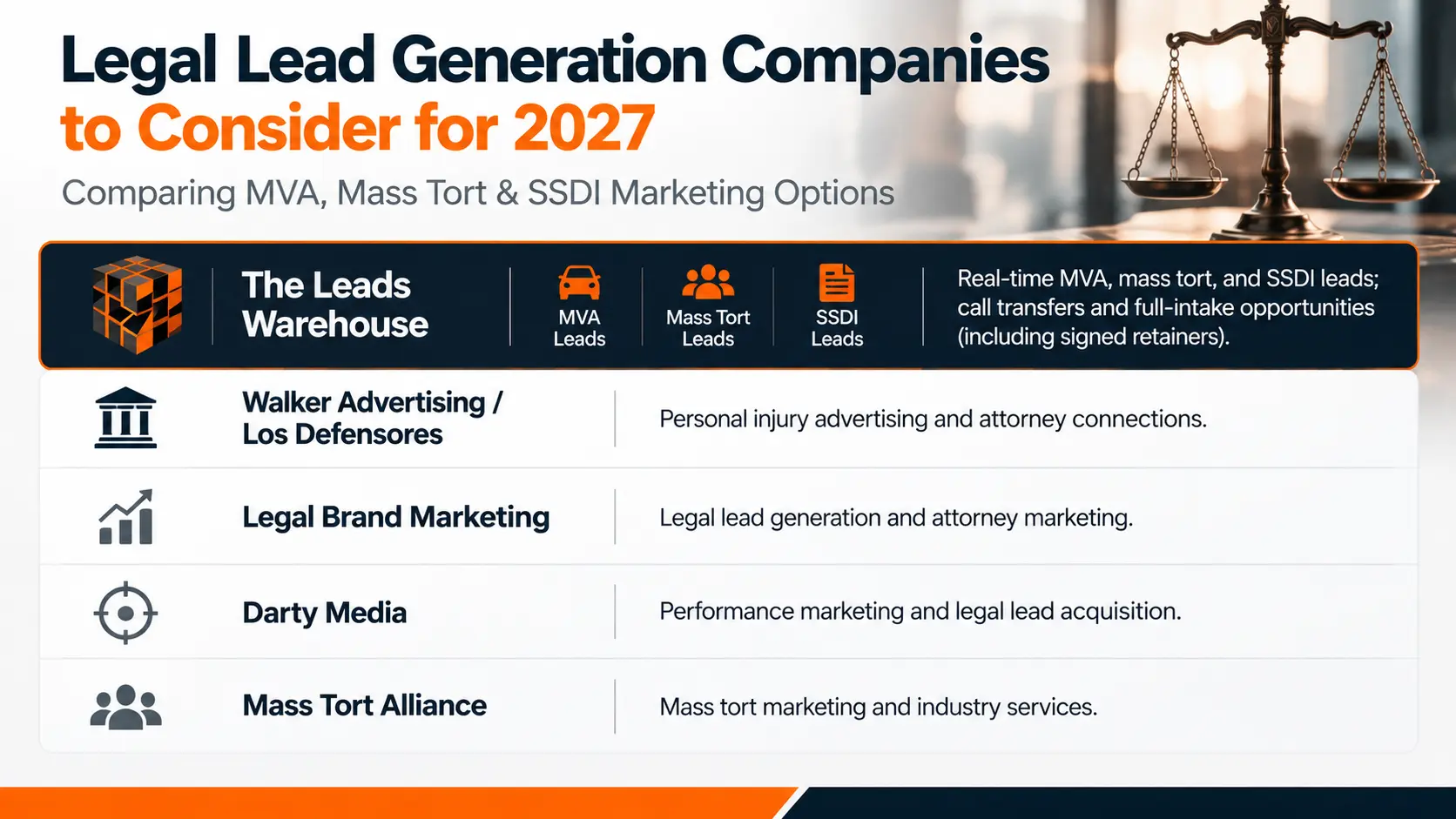
These descriptions reflect different business models, not independently verified performance rankings. Some providers specialize in advertising campaigns, while others supply consumer inquiries directly. The right choice depends on a firm’s practice areas, intake capacity, and marketing budget.
Best MVA lead providers – buying auto accident and motor vehicle accident leads
Auto accident leads represent an important acquisition channel for personal injury law firms. According to the National Highway Traffic Safety Administration (NHTSA), motor vehicle crashes remain a significant cause of injuries across the U.S. (read our blog, “Why Distracted Driving Is Keeping Demand For Motor Vehicle Accident Leads High in 2026”). However, not every accident produces a viable legal claim.
When firms buy motor vehicle accident leads, they should evaluate accident timing, reported injuries, geographic location, liability considerations, and existing representation. Real-time inquiries allow attorneys to reach consumers while their need for legal assistance may be immediate.
The Leads Warehouse offers motor vehicle accident leads through real-time co-registration and standalone form submissions. Additional qualification and intake options can help firms identify prospects matching their case requirements (read our blog, “What Are Motor Vehicle Accident Leads?”).
Best mass tort lead generation companies – qualified leads and signed retainers
Mass tort lead generation requires more detailed screening than many traditional personal injury campaigns. Potential claimants must often meet specific exposure, medical, and legal requirements before a firm can accept their cases.
Federal multidistrict litigation statistics demonstrate the continuing activity of complex litigation (read our blog, “What Are The Next Major Mass Torts? Emerging Litigation And Lead Generation Opportunities For 2027”). For attorneys, successful marketing means identifying consumers whose circumstances match active litigation criteria.
Mass tort providers may offer several qualification levels:
- Co-registration leads: Consumers expressing interest through related online offers
- Long-form leads: Prospects submitting detailed information about potential claims
- Full-intake leads: Consumers completing more extensive case screening
- Signed retainers: Prospective clients who have completed a defined intake and engagement process
Law firms purchasing mass tort leads should confirm screening requirements, exclusivity, and what constitutes a completed intake or signed retainer. Higher qualification levels may reduce internal screening work, but they do not guarantee case acceptance or recovery.
Best SSDI lead providers – finding qualified disability claimants
Social Security Disability Insurance represents another substantial market for legal lead generation. According to the Social Security Administration (SSA), approximately 2.26 million disability insurance claims were received during fiscal 2024. Many applicants seek representation after receiving an initial denial (read our blog, “Roughly Two-Thirds Of Initial SSDI Applications Are Denied – What That Means For SSDI Lead Buyers”). Others need assistance understanding application requirements or pursuing an appeal. However, not every disability applicant qualifies for legal representation.
When comparing SSDI lead providers, firms should consider application status, denial history, geographic eligibility, and consumer interest in speaking with an attorney. Real-time inquiries and qualified call transfers can help connect attorneys with consumers seeking assistance.
The Leads Warehouse supplies SSDI leads for firms building disability representation pipelines.
Real-time legal leads, call transfers, and full intake leads
Different legal lead products serve different intake operations. A firm with experienced outbound representatives may prefer larger volumes of real-time inquiries. Another may prioritize live conversations or extensively screened prospects.
| Lead Type | Primary Benefit | Best Application |
|---|---|---|
| Real-time co-reg leads | Affordable inquiry volume | Outbound intake teams |
| Real-time form-filled leads | More detailed consumer interest | Targeted legal campaigns |
| Call transfers | Live consumer conversations | Available intake representatives |
| Full-intake leads | More extensive case qualification | Specific acceptance requirements |

Choosing the appropriate format depends on staffing, case value, and marketing economics. Firms should also confirm which formats are available for each practice area rather than assuming every product is offered across all legal categories.
How much do legal leads cost?
Legal lead pricing varies by practice area, exclusivity, screening, and delivery method. Co-registration inquiries generally cost less than detailed form submissions. Call transfers and full-intake opportunities typically involve higher acquisition costs because additional engagement or qualification is required. Attorneys can expect to pay within these price ranges per lead:
- Real-time co-reg leads: $1 to $7 per lead
- Real-time form-filled leads: $200 to $750 per lead
- Call transfers: $60+ per call (SSDI only)
- Full-intake and signed retainer leads: $1,500 to $4,500+ per lead
Consider a hypothetical campaign purchasing 600 leads at $5 each. The firm spends $3,000. If five prospects become signed clients, its lead acquisition cost (CPA) is $600 per signed case, excluding staffing and other operating costs. A higher-priced campaign could produce better economics if it delivers more qualified cases. Therefore, attorneys should track contact rates, qualified consultations, signed retainers, and cost per signed case, rather than judging performance solely on lead price.
How to evaluate legal lead providers?
Before purchasing legal leads, law firms should establish clear acceptance criteria and performance expectations. Providers should explain lead sources, qualification methods, delivery processes, and applicable consumer consent documentation.
Four questions deserve particular attention:
- Qualification – Does the prospect meet the firm’s case requirements?
- Exclusivity – Is the inquiry shared with competing buyers?
- Compliance – Is appropriate consent and sourcing documentation available?
- Performance – What percentage of inquiries become qualified consultations and signed cases?
A small initial campaign can establish realistic benchmarks before increasing spending. Firms should also examine response times and intake procedures, since slow follow-up can undermine otherwise promising inquiries.
Choosing the right legal lead company for 2027
The best legal lead generation strategy depends on matching lead products to specific practice areas. MVA firms may prioritize immediate accident inquiries, while mass tort practices often require extensive screening. SSDI attorneys may focus on application status and denied claimants.
Law firms seeking to buy legal leads in 2027 should compare provider capabilities, qualification standards, and acquisition costs. Combining real-time inquiries, call transfers, and full-intake opportunities can create a more flexible marketing program.
The Leads Warehouse helps legal marketers source qualified consumer opportunities across these markets. With clear case criteria, consistent follow-up, and careful performance measurement, attorneys can build more predictable pipelines and improve their ability to turn inquiries into signed cases. Are you ready to talk about how you can grow your MVA, tort, and SSDI case pipelines?
About the author
James Schulze is the President and CEO of The Leads Warehouse, a marketing data company with over 20 years of experience in bringing lead generation solutions to companies selling into the home, automotive, financial, insurance, health and life, and legal sectors. He works directly with clients to optimize conversion strategies and ROI across multiple verticals.
Connect with James Schulze on LinkedIn:
https://www.linkedin.com/in/james-l-schulze
Read additional market analysis and commentary from James Schulze on Substack:
https://jameslschulze.substack.com
If you would like more information on how you can grow your motor vehicle accident, mass tort, and SSDI client bases, give The Leads Warehouse a call at 1-800-884-8371 or visit our website at https://theleadswarehouse.com.