

By James Schulze
This article discusses the growing power of embedded payment networks and the advantages they have over MCA providers. It also provides a blueprint for how independent MCA providers can compete and win against these embedded platforms.
The alternative business funding landscape is undergoing a major structural shift. Traditional financial models are colliding with data-driven technology. Historically, the Merchant Cash Advance (MCA) sector thrived on a simple value proposition: speed and accessibility for businesses rejected by conventional banks.
Today, that core advantage is under siege from two sides. First, traditional banks are deploying Artificial Intelligence (AI) underwriting engines to compress their weeks-long approval timelines into days or hours. Second, tech conglomerates and payment processors–such as Stripe, Square, and Shopify–now offer automated, instantaneous capital to their users. Because these platforms process the daily credit card sales of millions of merchants, they possess total, real-time visibility into an enterprise’s financial health.
This friction-free distribution model poses a fundamental question: How do independent brokers and small-scale funders survive when the payment processor can deposit capital into a merchant’s account with a single click?
The data shows that the market is not shrinking. Analysts project the global MCA market will reach $26.87 billion by 2030, sustaining a stable compound annual growth rate (CAGR) of 6.4% to 7.2%. The demand for non-bank capital remains absolute. However, winning in this environment requires a deep understanding of market positioning, underwriting limitations, and data optimization.
The strategic threat of embedded payment networks
To compete against embedded finance giants, MCA providers must first understand the structural advantages these platforms possess, including:
- Continuous Data Asymmetry – Platforms like Stripe see every transaction that a business processes. They do not need to request bank statements, tax returns, or credit scores. Their algorithms calculate risk continuously.
- Zero-Friction Distribution – When a merchant reaches a certain sales threshold, the platform pushes an automated notification directly to their dashboard. The merchant can accept a pre-approved advance instantly.
- Automated Clearing and Collection – Because the platform controls the payment gateway, repayment collection occurs automatically at the source. This practically eliminates the risk of human error or missed manual payments.
This system creates a highly efficient “app box.” For a standard, low-risk business seeking a modest funding amount, this automated solution is nearly impossible to beat on pure speed.
Market share metrics and who is taking the share
To understand how to compete, we have to look at the macroeconomic numbers. Is big tech actually stealing the traditional MCA broker’s lunch?
Look at the data from the payment giants. Stripe reported processing $1.9 trillion in total payment volume, growing at a staggering 34% year over year. Concurrently, the broader embedded business lending market is expanding at an estimated 25% to 30% annually.
Now compare that to the baseline growth. The traditional commercial banking sector is growing small business credit at a meager 3% to 5% annually. Meanwhile, the alternative MCA marketplace is growing at roughly 6.8%.
The math is clear: embedded finance platforms are growing significantly faster than both the alternative lending sector and traditional banks. Because big tech’s growth rate outpaces the benchmark industry growth, they are directly eating market share from traditional financial institutions. They are automating the low-hanging fruit, leaving traditional banks further behind and forcing independent brokers to pivot their sourcing strategies.
Restrictive traditional banking vs. alternative funding realities
Traditional banks remain structurally incapable of serving the fast-paced liquidity needs of small businesses. Even as banks implement AI underwriting to speed up back-end operations, their risk tolerance has not fundamentally changed. AI helps a bank say “no” in minutes instead of weeks, but it rarely converts a “no” into a “yes.”
The disparity in funding accessibility is best highlighted by industry acceptance rates:
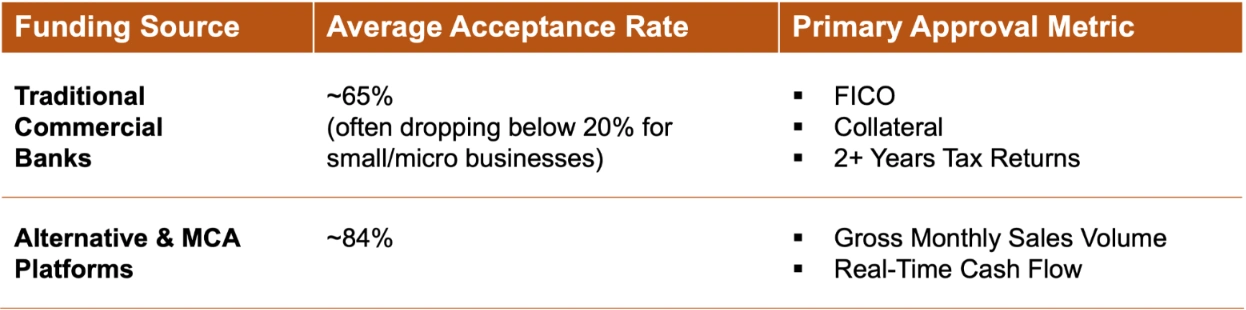
Traditional banks require pristine credit histories, hard asset collateral, and multi-year tax documentation. For a business experiencing rapid scaling for seasonal volatility, these restrictive boxes are impossible to check. The MCA vertical exists precisely because an 84% acceptance rate keeps the American small business economy moving when traditional infrastructure locks them out.
Structural vulnerabilities of embedded platforms
Despite their massive data advantages, embedded finance platforms operate within rigid, algorithmic guardrails. These systemic limitations provide a highly profitable landscape for agile independent MCA providers:
- Inflexible underwriting parameters – Algorithmic lending functions on standardization. If a business experiences a temporary, explainable anomaly – such as a seasonal inventory delay, a brief supply chain disruption, or a localized weather event – the software instantly triggers a rejection. The system cannot look past the raw numbers to understand the broader context of the business operations.
- Low capital ceilings – Embedded platforms excel at micro-advances, typically ranging from $5,000 to $50,000. They rarely extend to large-scale, high-dollar funding. Their risk models are not built to handle customized, multi-layered financing structures.
- Industry exclusion lists – Certain sectors are inherently incompatible with automated payment processors. Businesses that rely on cash transactions, high-value invoicing, milestone-based billing, or high-risk industries are frequently locked out of standard embedded lending options.
How MCA providers can out-position embedded platforms
Independent MCA providers must move away from generic, small-dollar transactions. Success requires evolving into a specialized, high-volume operational floor. This is how:
#1 – Be a partner, not big tech
Big tech offers the advantage of immediacy, but it does not offer partnership. Traditionally, people like to do business with people. In fact, a Yahoo Finance 2025 article reported that of 222 small businesses, almost 60% looked for funding from independent sources versus about 10% securing funding from an online-only source.
This gives an independent broker a massive advantage. Instead of looking at Stripe as a competitor, look at Stripe as a top-of-the-funnel interest creator. Big tech can stoke the demand while the independent broker closes the deal.
At The Leads Warehouse, we constantly recognize the value of scripting in closing deals. Adjusting scripting to acknowledge tech-created interest isn’t just an acceptance of reality, but it can be a differentiator in speaking to the merchant. It can build trust by allowing a merchant to point out why they deserve a merchant’s business.
#2 – Target complex, high-dollar verticals
Independent funders must focus on businesses that require human underwriting and large capital allocations. Sectors requiring $250,000 to $1,000,000+ in working capital are completely underserved by automated apps.
Key industries primed for custom MCA underwriting include:
- Heavy construction and contracting – Companies that operate via large commercial contracts with delayed, milestone-based payouts.
- Logistics and fleet trucking – Enterprises with variable fuel expenditures, heavy upfront equipment costs, and fluctuating invoice cycles.
- Healthcare and specialized clinics – Operations dealing with complex insurance reimbursements and Medicare billing lags.
- B2B manufacturing – Manufacturers that must purchase massive raw material inventories months before realizing final sales revenue.
These businesses require an experienced underwriter who can evaluate long-term contracts, accounts receivable aging schedules, and operational health. A human broker can structure a bespoke solution that aligns with these unique revenue cycles.
To win these more complex deals, it is not just a matter of the right leads. Broker skill is paramount. To win the business of a larger merchant, a lender cannot send the ubiquitous “yo, need money by this weekend?” SMS that is far too prevalent in the MCA industry. And an MCA broker needs first-rate funding relationships to offer the flexibility a big deal requires.
#3 – Maximize capital efficiency in lead acquisition
Chasing live, exclusive internet leads via public ad networks has become a highly inefficient use of capital. Bidding wars on major ad networks drive acquisition costs to unsustainable levels. Further, these real-time inquiries are heavily saturated by competing shops within seconds of submission.
To scale an outbound sales engine profitably, elite brokerages utilize high-intent historical data, specifically aged submission files. Aged submissions represent merchants who previously completed a rigorous, multi-field funding application (read our blog, “What Are MCA Leads? Types, Costs, And How Funding Companies Use Them”). These files contain verified business names, contact information, and documented revenue metrics. The merchant has already demonstrated a clear intent to utilize alternative financing.
By purchasing redacted tranches of some MCA leads in bulk, an independent shop acquires deep intent data at a fraction of the cost of live leads. This strategy preserves marketing capital while providing a steady volume of targets for the sales floor.
This winning strategy is based on statistics we see all the time on our real-time leads. The reality is that 80% of deals close between touch 5 and 12, and 50% of deals take over 90 days to close (Ask for The Leads Warehouse’s matrix of the number of calls vs. connections vs. contacts to closes). A business owner looks in real-time, but moves forward based on need. A well-designed drip campaign keeps an MCA provider front and center so availability meets need.
#4 – Deploy an advanced outbound tech stack
Competing against automated tech requires adopting automated tools. Lean brokerages must replace manual operations with specialized outbound software, including:
- Predictive AI Voice Engines – These platforms automate the dialing process, filtering out dead lines, busy signals, and answering machines. They instantly hand off live, engaged merchants directly to experienced senior brokers.
- Structured SMS and Multi-Channel Flows – Reaching a merchant requires hitting multiple touch points. Automated text messaging and email flows keep your brand top-of-mind before and after a voice connection occurs.
- Ringless Voicemail (RVM) Drop Seeding – Dropping non-intrusive, direct-to-voicemail messages allows brokers to generate inbound callbacks from business owners at a highly predictable rate.
The key to making tech work is twofold. Required registrations like A2P and 10DLC are a necessity, and if a business fails, messages simply won’t deliver. Secondly, proper scripting is paramount. A good script doesn’t just close a deal, but it allows for message deliverability. Advanced AI message monitoring will block delivery of messages that use words like “instant” or “limited.” A well-designed script wins deals and ensures SMS messages inbox.
#5 – Execute “second chance” retention campaigns
Aged submission lists are highly effective for targeting historical funding cycles. An enterprise that applied for an MCA three to six months ago is typically approaching a critical operational crossroad. They are either ready for a renewal, trapped in an aggressive short-term repayment schedule, or looking to clear an existing position.
By running systematic outbound campaigns targeting these specific intervals, brokers can present a well-timed alternative option. A specialized broker can evaluate the merchant’s current position and offer structured bridge funding or a consolidation strategy that improves the merchant’s daily cash position.
Again, scripting matters to make these campaigns work. Reactivating leads requires specific second-chance scripting. The smart MCA shop pressure tests a variety of scripts to determine effectiveness and then scales around the winning messages.
Conclusion
The growth of embedded finance does not signal the end of the independent funding sector. Instead, it draws a clear line through the marketplace. Simple, transactional micro-advances will continue to shift toward automated payment processors. The future for independent operators starts with a personal touch that big tech cannot provide. Top MCA providers rely on more complex, high-volume, and deeply analytical segments of the economy. By combining advanced outbound sales technology with cost-effective, high-intent historical data assets, independent MCA providers can scale their operations efficiently. Human ingenuity, adaptive underwriting, and aggressive operational execution remain irreplaceable assets in the alternative financial landscape. Are you ready to talk about how you can grow your MCA sales pipeline?
About the author
James Schulze is the President and CEO of The Leads Warehouse, a marketing data company with over 20 years of experience in bringing lead generation solutions to companies selling into the home, automotive, financial, insurance, health and life, and legal sectors. He works directly with clients to optimize conversion strategies and ROI across multiple verticals.
Connect with James Schulze on LinkedIn:
https://www.linkedin.com/in/james-l-schulze
Read additional market analysis and commentary from James Schulze on Substack:
https://jameslschulze.substack.com
If you are serious about growing your MCA business, the right blend of sales leads is critical. Our team works with funding companies to maximize their ROI on MCA sales leads. Call 1-800-884-8371 or visit The Leads Warehouse to get started.