

By James Schulze
This article discusses homeowner data, cell phone data, and home warranty aged, real-time and inbound call leads that companies can use for their prospecting. It offers insights on lead conversion through strong follow-up and qualification. It also explains how companies can measure marketing ROI to compare and select the right data and lead options for their sales teams.
Home warranty companies need a reliable way to reach homeowners, generate qualified prospects, and convert those opportunities into customers. Traditional home warranty leads can support growth, but depending entirely on incoming inquiries limits control over marketing volume. Purchasing targeted consumer data provides another option. Companies can identify potential customers, launch direct mail campaigns, and use compliant outbound marketing to build a consistent sales pipeline.
The Leads Warehouse has supplied lead generation solutions since 2005, bringing more than 21 years of industry experience to customer acquisition. TLW offers consumer data, aged and real-time home warranty leads, and home warranty inbound calls. Consumer data is especially attractive because of its broad availability, affordable pricing, and extensive targeting options. Combined with structured follow-up, these products help home warranty providers build campaigns around their budgets, geographic markets, and sales capabilities.
At The Leads Warehouse, we have extensive knowledge of consumer data and how it can be used effectively. We offer clients a data dictionary with over 360 variables to curate the exact customer profile required. Additionally, The Leads Warehouse consumer data is available with lifestyle clusters, which are predetermined sets of consumers who are grouped into demographic blocs to make it easy to buy consumer data. Purchasing consumer data from The Leads Warehouse for use in home warranty prospecting is a time-proven client acquisition strategy.
Buy consumer data for home warranty customer acquisition
Buying consumer data allows home warranty companies to reach precisely selected homeowners without waiting for new inquiries. These records support direct mail and other permitted outbound marketing campaigns. Companies can select geographic areas, property characteristics, and household attributes to build prospect lists that match their ideal customers. Unlike leads generated through a specific home warranty inquiry, consumer data provides a broader audience for proactive marketing.
The Leads Warehouse offers access to more than 35 million consumer records and 76 million cell phone records, compiled from public records, surveys, and other data sources (read our blog, “What Is Consumer Data? A Guide For Marketers”). Information is refreshed quarterly, with some feeds updated more frequently. This availability allows marketers to request targeted lists, test different audiences, and expand successful campaigns. Rather than relying on unpredictable inbound lead volume, home warranty companies can plan outreach around available records and their existing sales capacity.
Target homeowners with 360+ consumer data variables
The real advantage of buying homeowner data is the ability to identify specific consumer profiles. TLW’s data dictionary includes more than 360 variables, with over 100 available targeting filters. Home warranty companies can move beyond broad zip code selections and focus on property ownership, home age, market value, household characteristics, and purchasing behavior. These details help marketers create more relevant offers while reducing spending on audiences that do not match their preferred customer profile.
For example, a home warranty company could target owner-occupied, single-family properties built before 2005, valued between $250,000 and $500,000, within selected zip codes. The database also includes indicators for air conditioning, home purchase dates, length of residence, and prior responses to mailed offers. These fields create opportunities to segment campaigns by property characteristics and consumer behavior, although actual record counts depend on available matches.
Some of the most frequently used targeting variables include:
- Property – Homeownership, dwelling type, construction year, and market value
- Geography – State, county, zip code, carrier route, and census tract
- Household – Income ranges, age, household size, and length of residence
- Marketing behavior – Mail-order purchasing and response indicators
Consumer data pricing – affordable lists for direct mail campaigns
Consumer data for sale can be substantially more affordable than purchasing individual inbound inquiries. TLW’s full-output pricing begins at $0.05 per record for 10,000 records and declines to $0.01 at a quantity of 500,000 records. This pricing gives home warranty marketers flexibility to test smaller audiences before expanding successful campaigns. The initial minimum order is $500, while subsequent orders have a $2,500 minimum.
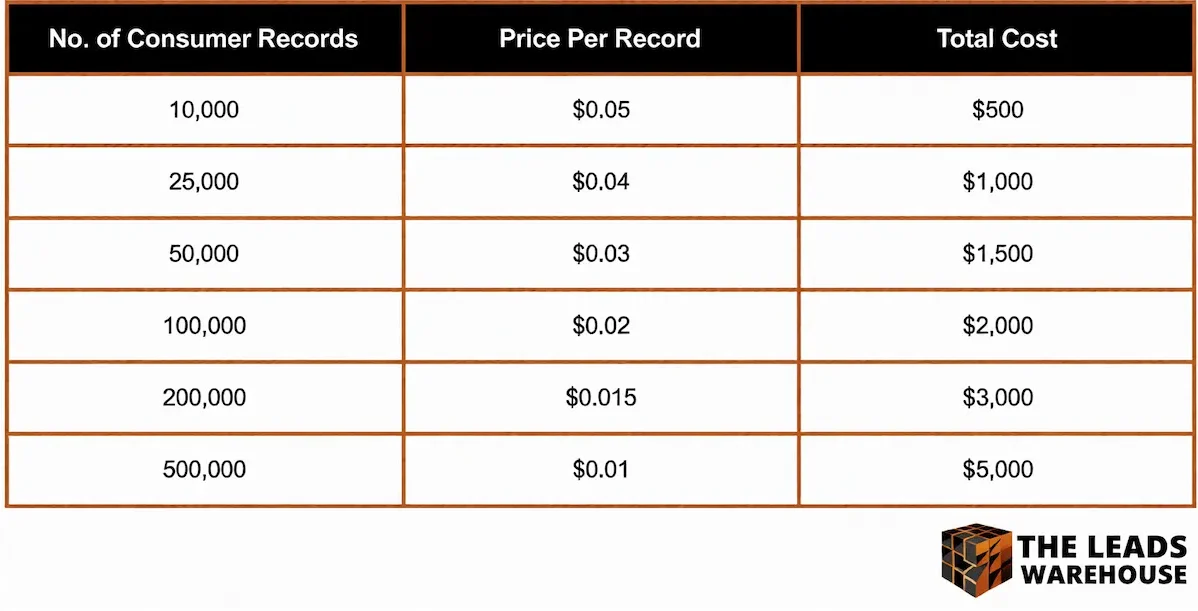
A company purchasing 100,000 targeted consumer records spends $2,000 on the data itself. Printing, postage, staffing, and campaign execution are additional expenses. Direct mail marketing lists are especially useful for home warranty offers because marketers can select homeowner audiences and deliver physical advertisements directly to their addresses. Postcards, personalized letters, and follow-up mailings can introduce coverage options, promote seasonal offers, and encourage consumers to request additional information.
Direct mail also supports repeatable campaigns. Companies can test different homeowner segments, measure responses, and adjust their targeting before making larger purchases. TLW’s data includes mailing addresses processed through the Coding Accuracy Support System (CASS), helping improve address accuracy. Marketers should also apply appropriate mailing suppressions and maintain accurate campaign records. With affordable data and organized follow-up, direct mail can become a consistent component of home warranty customer acquisition.
Consumer phone lists – DNC compliance, SMS and RVM marketing
Consumer phone lists allow home warranty companies to supplement direct mail with outbound calling campaigns. TLW provides landline and cell phone options, along with DNC indicators and geographic information. There is approximately 90% phone number connectivity, although actual campaign results will vary. These features help companies select appropriate audiences and organize outreach, but purchasing consumer records does not automatically establish permission to call or text every contact.
Companies using consumer data for telemarketing must follow applicable Do Not Call (DNC) and TCPA requirements. Federal rules generally require National DNC screening using registry information accessed within the preceding 31 days. Telemarketing calls are generally restricted to 8:00 a.m. to 9:00 p.m. at the recipient’s location, with additional state requirements potentially applying. Manual dialing does not eliminate DNC obligations, and agencies must honor internal opt-out requests. The FTC’s Telemarketing Sales Rule guidance explains these requirements.
SMS and ringless voicemail (RVM) offer additional marketing options when appropriate consent exists. Business texting also requires applicable A2P 10DLC registration, while prerecorded marketing messages and ringless voicemail have separate TCPA requirements. The FCC’s ringless voicemail ruling confirms that ringless voicemail to wireless phones is covered by TCPA calling rules. Proper compliance allows marketers to focus on permitted contacts and build sustainable campaigns rather than treating purchased phone numbers as unrestricted calling lists.
For more information on running compliant telephone, text, and email campaigns, read our blog, “Why Is It So Hard To Connect With Prospects Today?”
Home warranty lead follow-up – turn data into customers
Home warranty lead follow-up is essential whether a company purchases consumer data, aged leads, or real-time inquiries. Consumer data requires a cold prospecting approach that introduces the company and explains the potential value of coverage. Co-registration leads require agents to reference the consumer’s previous interest and confirm whether a home warranty is currently relevant. In both cases, a single unsuccessful contact attempt should not automatically end the opportunity when further outreach is permitted.
With its two decades of experience in the lead generation space, TLW has identified four factors that have the greatest influence on campaign performance: lead quality, outreach cadence, deliverability, and scripts. A company can purchase excellent prospect data and still struggle if its phone numbers are flagged, its representatives lack effective scripts, or its follow-up is inconsistent. Direct mail campaigns also benefit from repeated, measured outreach. Marketers should track response rates, qualified conversations, appointments, and completed sales while respecting contact preferences and applicable communication rules.
Buy aged and real-time home warranty leads
Companies looking to buy home warranty leads can supplement consumer data campaigns with aged leads and real-time co-registration inquiries. Both products originate from consumer survey or co-registration activity, but they differ in when the information is delivered. Aged home warranty leads offer an affordable way to build outbound prospecting volume, while real-time home warranty leads allow representatives to contact consumers shortly after submitting their information.
Aged leads can be particularly useful for companies with established calling teams and consistent follow-up procedures. Consumers who previously expressed interest may become more receptive when appliance problems, repair costs, or household circumstances change. Real-time leads require faster response times because the inquiry is recent. Neither product guarantees a sale, and both require qualification. Companies should review available consent records, confirm homeownership and coverage interest, and match outreach to the consumer’s circumstances (read our blog, “Best Home Warranty Leads – Where To Buy & How To Compare Providers”).
Home warranty inbound calls – live consumer opportunities
Home warranty inbound calls provide direct conversations with consumers who initiate contact after viewing relevant advertising. These calls can create valuable sales opportunities because representatives speak with interested prospects immediately. However, consistent inbound call volume can be difficult to generate, making it less predictable than purchasing available consumer data or co-registration leads. Companies should maintain adequate staffing, answer calls promptly, and follow up with interested consumers who need additional time before purchasing coverage.
Home warranty lead conversion and marketing ROI
Successful home warranty marketing requires measuring the complete customer acquisition process. Companies should track data purchased, campaign expenses, consumer responses, qualified conversations, and completed sales. The most useful financial measure is customer acquisition cost (CPA), calculated by dividing total acquisition expenses by new customers acquired. This approach allows marketers to compare direct mail, outbound calling, aged leads, real-time leads, and inbound calls using actual campaign performance.
For example, a campaign spending $2,000 on consumer data and $3,000 on marketing execution has $5,000 in total expenses. If it generates 25 customers, acquisition costs average $200 per customer. If 50 customers are acquired, the CPA falls to $100. These examples illustrate the calculation rather than guaranteed results. Companies that test targeting, maintain compliant follow-up, and track conversion performance can identify which campaigns deserve additional investment.
The Leads Warehouse offers targeted consumer data for sale, aged and real-time home warranty leads, and inbound call solutions for companies seeking new customers. With economically-priced records, strategic homeowner targeting, and multiple acquisition options, home warranty marketers can build campaigns around their specific goals. Explore available homeowner data and cell phone data, home warranty leads, or schedule a consultation to discuss audience selection, pricing, and campaign requirements. Are you ready to talk about how you can grow your home warranty sales pipeline?
Ready to Grow Your Home Warranty Sales Pipeline?
Get instant access to consumer data, and compliant, high-intent home warranty aged, real-time, and inbound call leads.
About the author
James Schulze is the President and CEO of The Leads Warehouse, a marketing data company with over 20 years of experience in bringing lead generation solutions to companies selling into the home, automotive, financial, insurance, health and life, and legal sectors. He works directly with clients to optimize conversion strategies and ROI across multiple verticals.
Connect with James Schulze on LinkedIn:
https://www.linkedin.com/in/james-l-schulze
Read additional market analysis and commentary from James Schulze on Substack:
https://jameslschulze.substack.com
If you would like more information on how you can grow your home warranty sales, give The Leads Warehouse a call at 1-800-884-8371 or visit our website at https://theleadswarehouse.com.